
Harris County Parole Versus Probation
Parole and probation can both require a person to report in the community, but their legal origins differ. The Georgia State Board of Pardons and Paroles decides parole for eligible state prisoners. A court orders probation as part of a sentence. Someone may leave Harris County Jail on probation without ever serving a Georgia Department of Corrections prison term. By contrast, parole follows a prison sentence and a board release decision.
For felony probation and parole, the Georgia Department of Community Supervision handles field supervision. Misdemeanor probation may be administered under a local court arrangement, so the sentencing order and court file control. These distinctions determine where to look and prevent a county jail record from being mistaken for a state parole record.
| Point | Parole | Probation |
|---|---|---|
| How it begins | Board release from a prison sentence | Sentence imposed by a court |
| Primary record | Parolee search and board decision records | Sentencing order and supervision record |
| Field agency | DCS for Georgia parole | DCS for felony probation; local arrangement may apply to misdemeanors |
| Key dates | Parole begin and end dates | Term, conditions, and discharge set by court records |
- Parole
- Conditional community release after part of a prison sentence.
- Probation
- A court-ordered sentence served under stated conditions in the community.
- Discharge
- The formal end of a supervision term.
- Absconder
- A person alleged to have stopped reporting or left supervision without permission; the status must be confirmed by an agency record.
Check Harris County Supervision Status
A reliable check starts with the sentence, not with an assumption based on a missing roster entry. Harris County Jail's custody page concerns jail custody. State parole tools address a different stage. The board's public parolee search includes labels for parole begin and parole end dates, while the board's pre-release TPM tool concerns a tentative month rather than current parole status.
- Decide whether the person had a state prison sentence, a felony probation sentence, or a local misdemeanor case.
- For a former state prisoner, search the parolee database by the most exact name information available and compare identifying details.
- For a person still in prison, use the Inmate TPM Lookup information. Treat a tentative parole month as a review target, not proof of release.
- For felony supervision, confirm the relevant office through DCS. For misdemeanor probation, check the sentencing court and its order.
- If dates conflict, request the agency or court record that created the supervision term. Do not infer a warrant or discharge from an absent result.
The broader Harris County released inmate search explains how to compare jail, court, GDC, and release records when the correct custody track is not yet clear.
Harris County Supervision Office Route
Harris County does not have a separately listed DCS field office in Hamilton. The official DCS Columbus field office serves Harris County as part of the Chattahoochee Circuit area. That regional structure matters: a search for a Hamilton-only probation or parole office can miss the office responsible for felony field supervision.
Georgia DCS Columbus Field Office
1334 Second Avenue
Columbus, GA 31901
Phone: (678) 783-4337
Hours: Monday-Friday, 8:00 a.m.-4:30 p.m.
The field office can provide office context, but the parole board's database is the better first source for public parole begin and end dates. Questions about a probation sentence may also require the Harris County court file. DCS lists its open-records custodian at 404-463-2072 when a public agency record, rather than a status check, is needed.
The State Board of Pardons and Paroles homepage shows the statewide decision system used for Harris County cases. The image below depicts that official source and helps distinguish board decisions from DCS field supervision.
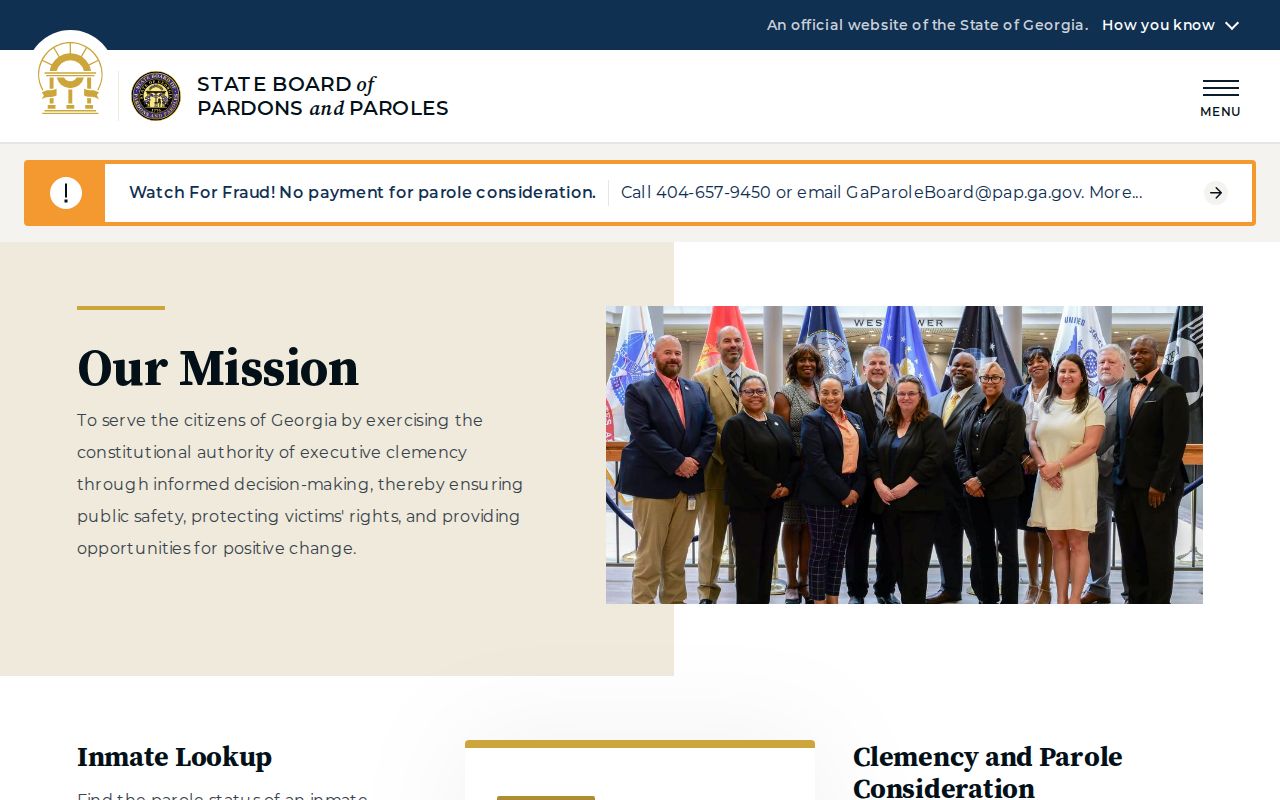
The board source is used for parole decisions and searches; the Columbus DCS office is the local field-supervision route after release.
Harris County Parole Decision Records
Georgia does not use a county courthouse-style hearing calendar for ordinary Harris County parole decisions. The statewide board reviews case files, applies decision guidelines, votes, and may set a tentative parole month or deny parole. According to the Georgia parole process, a majority board vote is required, and a prior decision may change at any time before the release date.
The eligibility and guidelines source describes recommendations based on crime severity and risk. The board's public FAQ says there is no set decision timeline and that a Hearing Examiner reviews the case file and calculates a guidelines recommendation. For most people, therefore, the useful public path is the TPM lookup before release and the parolee database after release, not a search for a Harris County hearing date.
A TPM means tentative parole month. It is when the board expects to complete final review and, if appropriate, set release. It can depend on conduct or program completion. It is not an order that the jail or prison must release the person in that month.
Harris County Supervision Violations
Supervision conditions come from the parole authority, sentencing order, and instructions given by the supervising agency. They may govern reporting, travel, treatment, conduct, or other person-specific duties. A violation allegation can lead to agency action or a court process, but it does not by itself prove that supervision was revoked. The controlling record is the board, DCS, or court action.
No official Harris County parole-absconder list was found in the reviewed sheriff sources. The sheriff's Submit a Tip route and OffenderWatch system serve different purposes and should not be treated as an absconder database. Likewise, no result in the current jail roster does not show that a person is wanted. For parole, check the statewide record and DCS. For a local warrant, contact the sheriff or the court tied to the case.
Georgia VINE can provide participating custody-status notifications, but it is not a supervision registry. It may help when a violation results in custody. It cannot replace the parolee search, a DCS record, or a probation order.
Note: Confirm an alleged absconder or warrant status with the responsible agency before relying on a secondhand claim or an empty public search.
Harris County Reentry Resource Links
The Harris County Sheriff's Office app publishes a local community-resource menu that may be useful after release. Its links include Family Connection, Focus Ministries, New Horizons, Alcoholics Anonymous, Narcotics Anonymous, and the 988 Lifeline. These are navigation options surfaced by the sheriff, not promises that a person qualifies for a program or that a service has space.
Practical support and legal supervision are separate. A community group does not verify parole or probation, change conditions, or excuse a missed report. The person should follow the instructions in the supervision order and use DCS Columbus or the relevant court for official questions. Local resource links may still help someone seek support while complying with those terms.
Harris County Supervision Discharge
Supervision ends through an official discharge, expiration, court action, or other action authorized by the body that controls the term. A parole end date in the public interface is useful, but records-grade confirmation may require the State Board of Pardons and Paroles or DCS. Probation discharge should be checked against the court order and case docket, especially if the term was modified or ended early.
The Georgia Open Records Act generally permits requests for public agency records, subject to exemptions. DCS states that requests can result in billing. A narrow request should identify the person, case or supervision number if known, the type of supervision, and the date range. Sensitive case-management material may be withheld even when basic status or dates are public.
Discharge from supervision does not rewrite the old custody record. It means the parole or probation term ended. Sealed, restricted, or First Offender records may have different public visibility, so a missing public entry is not proof that no supervision ever existed.