
Harris County Release Date Types
Three date types often get grouped together even though they come from separate authorities. Harris County Jail release depends on bond, court action, completion of a local sentence, transfer, or a hold. A Georgia Department of Corrections date concerns a state-prison sentence. A tentative parole month, or TPM, is the parole board's review target and is not a guaranteed release date.
A pretrial detainee usually has no computed sentence-end date. The sheriff's Harris County Jail FAQ says that when bond is not made or granted, a preliminary hearing usually occurs at the jail by Zoom and can lead to bond reconsideration or bind-over. A future court decision, not elapsed jail time alone, may control release.
| Date | What it means | Best source |
|---|---|---|
| County jail release | Departure after bond, order, local sentence, or transfer | Jail and court record |
| GDC maximum or release date | State sentence-administration field, when shown | GDC offender record |
| Tentative parole month | Month for final board review and possible parole setting | Parole board TPM lookup |
| Actual release | Custody departure recorded by the holding agency | Originating agency release record |
Lookup Harris County Release Dates
Begin with the place and sentence. The Georgia Find an Offender service directs county-jail inquiries to the county, while GDC covers state custody and past state custody. A person who bonded out from Harris County Jail without a state sentence may never appear in the GDC system. Someone transferred to GDC or serving a state term at Harris County Correctional Institution should be checked through state records.
- Confirm whether the person is at Harris County Jail, Harris County Correctional Institution, another GDC facility, or no longer in custody.
- For the county jail, call 706-628-4211 and compare the jail response with the court docket. Ask about the release date or the next legal event, not a guessed sentence calculation.
- For state custody, open GDC Find an Offender, accept its disclaimer, and search by GDC ID, case number, or exact name. Narrow only with known identifiers.
- Review active facility, noncustody status, sentence information, and maximum or release fields when available. GDC says records should be verified in writing with Inmate Records and Information.
- Check the Inmate TPM application if parole timing applies. Keep the TPM separate from the sentence-end date.
- When sources disagree, use the sentencing court, jail records unit, GDC records office, or parole board as appropriate to the disputed field.
A released person may disappear from a live custody roster. That does not erase the release record. The Harris County released inmate search covers the full records-request and court-confirmation path for a completed county release.
Harris County GDC Date Fields
The GDC query requires acceptance of a disclaimer before its form appears. Search options documented by Georgia include name, ID or case number, age, and other identifying facts. Results can vary by person, but a state record may show a GDC ID, physical descriptors, custody or noncustody status, institution, sentence information, a release or maximum date, and a photograph when one is available.
| Field | Use in a date check |
|---|---|
| GDC ID | Distinguishes people with similar names |
| Current status | Separates active state custody from released or noncustody status |
| Institution | Shows the state facility tied to an active record |
| Sentence information | Connects the date to the state sentence |
| Maximum or release date | Provides the date field when maintained and displayed |
Public results are useful for orientation, not always records-grade proof. GDC instructs users to verify information by written correspondence with Inmate Records and Information, P.O. Box 1529, Forsyth, GA 31029. A court order can also resolve a conflict about the sentence imposed, but GDC remains responsible for its own sentence administration.
Harris County Tentative Parole Month
The Georgia parole board's TPM explanation says a tentative parole month marks when final review will be completed and a parole release date may be set. Conditions can include good conduct and successful completion of a required counseling or treatment program. The board may revise a prior decision before release.
Excluding life sentences, the board's parole process says consideration may result in a future TPM or denial of parole. This makes the language critical. A TPM is not an actual release event, a promise, or a county jail date. After release, the parolee database can show parole begin and end labels, while DCS handles community field supervision.
The official TPM page shown below explains the board's tentative date concept for Harris County state prisoners.
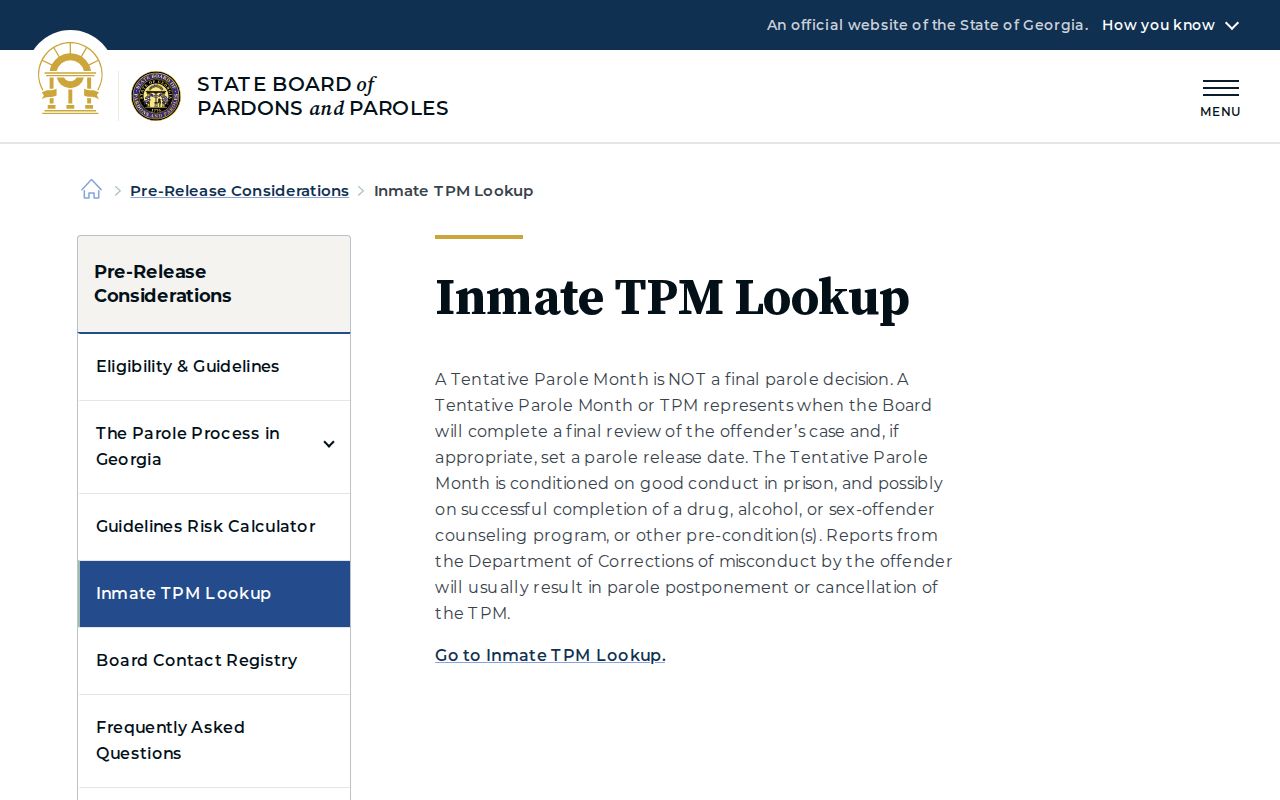
The screenshot represents the parole timing source, which must be read alongside GDC sentence fields rather than substituted for them.
Harris County Sentence Credit Rules
Georgia uses work incentive credits and Performance Incentive Credit, known as PIC. O.C.G.A. § 42-5-101 authorizes GDC work incentive credits for institutional attainment, satisfactory work, and compliance with department behavior standards. GDC describes PIC as a way for eligible offenders to reduce length of stay through progress in education, vocational work, treatment, assignments, and good conduct.
The GDC PIC program page shown below is the official source for that earned-credit framework.
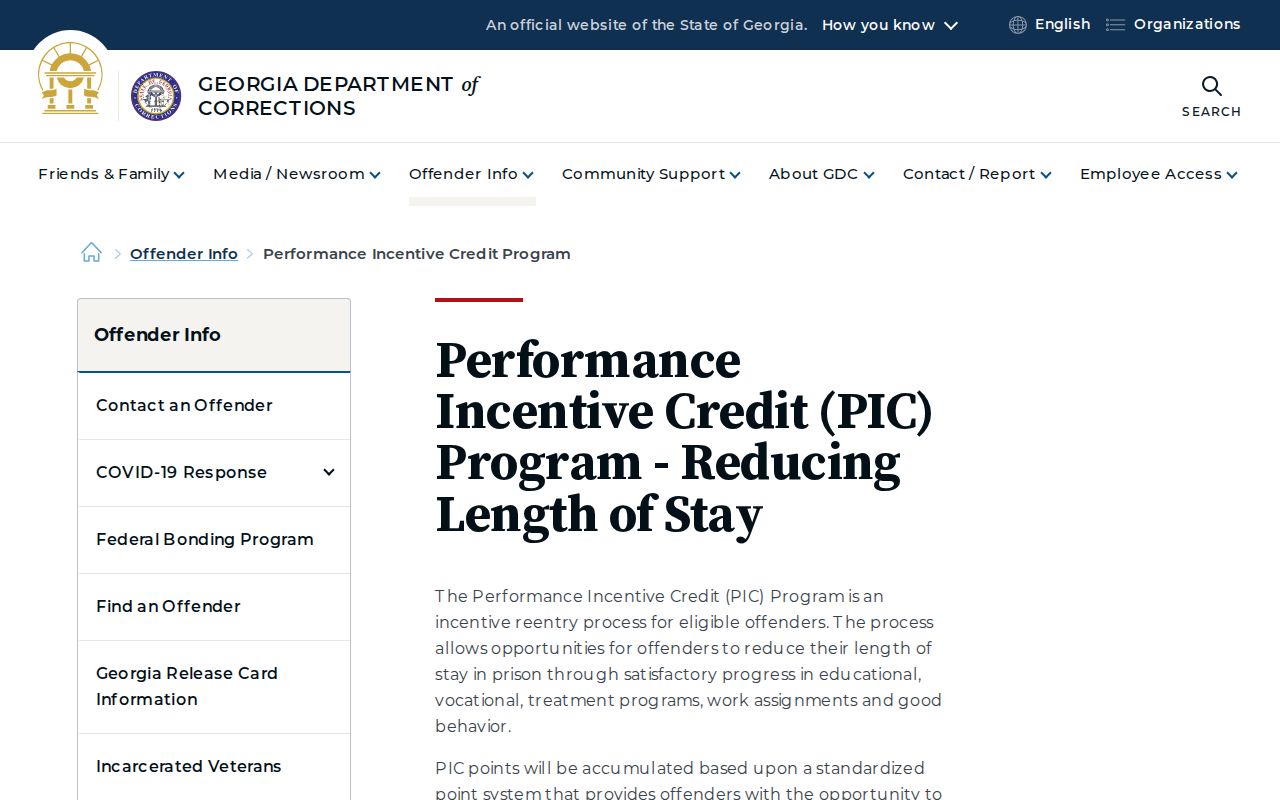
Those credits apply only within the eligibility and calculation rules for the state sentence; they are not a universal discount from every Harris County term.
The parole decision guidelines connect PIC with the TPM. When parole is tentatively scheduled, the board sets both a TPM and a PIC date. The gap is the most a TPM can advance for good conduct, while poor performance can add time without a fixed cap. Thus, an early PIC date is not the same as an already granted release.
Note: Credit eligibility and the amount actually applied are individual sentence facts that should be confirmed through GDC or the parole board.
Harris County Parole Eligibility Limits
Georgia should not be described with a broad, automatic “85 percent rule.” Release timing depends on the conviction statute, sentence, and parole restrictions. Under O.C.G.A. § 42-9-45, the general framework makes misdemeanor sentences eligible after six months or one-third, whichever is greater, and felony sentences after nine months or one-third, whichever is greater. Statutory exceptions can override those starting points.
O.C.G.A. § 17-10-6.1 governs serious violent felony sentencing and parole limits. Repeat-offender rules under O.C.G.A. § 17-10-7 can also alter ordinary expectations. Mandatory minimums and offense-specific terms matter. Therefore, multiplying a sentence by a single percentage can yield a false Harris County projected release date.
Eligibility is only the point at which parole may be considered under the applicable rule. It is not a grant. The board may deny parole or set a later tentative month, and sentence administration may still reflect credits, restrictions, and the maximum term.
Why Harris County Dates Change
A projected date can move because different officials control different parts of the process. The court controls its orders and sentence. GDC administers the state sentence and qualifying credits. The parole board controls parole decisions. Another agency may place a lawful hold or detainer that prevents community release even after Harris County custody ends.
| Factor | Possible effect | Confirm with |
|---|---|---|
| Bond or new court order | Creates, cancels, or changes a county release path | Jail and court clerk |
| PIC or work credits | May advance an eligible state-prison target | GDC and parole board |
| Poor conduct or unmet program | May delay a TPM or prevent an advance | Parole board or GDC |
| Parole vote or reconsideration | Sets, denies, or changes tentative timing | State parole board |
| Detainer or transfer order | Moves the person to another agency instead of the community | Holding and receiving agencies |
| Sentence correction | Changes the calculation after a court or records update | Court and GDC records |
An ICE, federal, or other-county transfer can be recorded as release from one facility while custody continues elsewhere. “Released from Harris County” and “free from all custody” are not interchangeable. Always identify the receiving agency when the record shows a transfer or hold.
Confirm Harris County Actual Release
On the expected date, check the agency that physically holds the person. For Harris County Jail, use the jail and court records. For a GDC prisoner, review the offender record and seek written verification when accuracy matters. If parole is involved, compare the board result with the custody status and later parole begin date.
Georgia VINE can send a custody-change alert when the person and agency participate. It is strongest as a notification layer, not as a permanent archive. The VINE Inmate Check describes registration and its limits. An alert should still be confirmed through the jail, GDC, parole board, or court that created the underlying event.
If a public date vanishes or changes, preserve the identifying details and ask the source agency about the current record. Do not assume the earlier date was final. Restricted records, data updates, transfers, and recalculation can each change what a public search displays.